At 8:19 on November 16, I stopped and took a screenshot. Charlie, our test rat for Furever Home, was in Blender’s Pose Mode, with controls visible around his body, legs, and tail. For the first time, we had multiple ribbons working together on his rig.
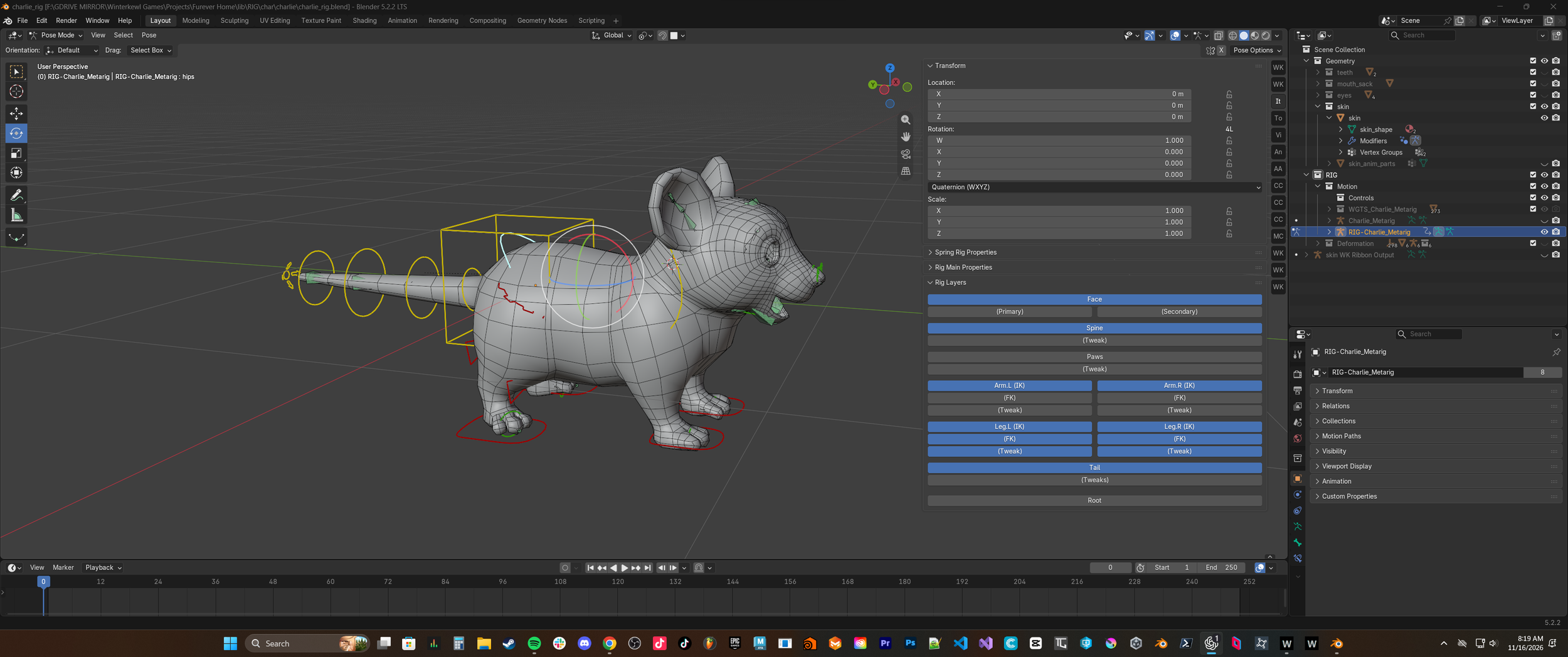
Charlie’s first multi-ribbon deformer rig.
Over the previous 24 hours or so, I’d been thinking about a workflow I’d come to rely on in proprietary studio software. Years of using it had taught me what I needed from it. They’d also given me plenty of time to imagine how I wished it worked. I didn’t know how the original tools were implemented. What I could describe, in detail, was the workflow I wanted to use.
That was the design brief I brought to OpenAI’s Codex. We worked through how I wanted to bind several ribbons to one mesh, paint where each ribbon influences the skin and where the skin follows it, and mirror that work across the character. I tested the pieces in Blender as we developed them. By the time I took the screenshot, I could start posing Charlie and see how they behaved together.
That’s what made the moment worth saving. The tool I got to try on Charlie was the version of the workflow I’d always wanted. It now lives in Winterkewl Workshop, where we can keep changing it as we learn what our characters need.
For an independent studio, an independent developer, or anyone making something, that changes what’s possible. You can start with an idea for how the computer ought to work, describe it in your own terms, and build enough of it to find out whether you were right. When that first pass takes about a day, more of the ideas you’ve been carrying around become worth trying.
I think that loop will get shorter as people use AI to build better ways of working with AI. I’m excited to see what people invent when they can spend more of their time deciding how they want to work.
This morning, I got to open Charlie in Blender and ask, how do I want this rat to move?